What Sweden and Chile teach padel clubs about overcapacity
PadelEco Team
Padel club operations
4 min read
On this page
What happened to padel in Sweden?
Between 2019 and 2022 Sweden built more padel courts than any country outside Spain. According to European Business Magazine, the country went from a few hundred courts to more than 4,200 in 36 months. Uppsala alone went from 14 courts to nearly 100 in a single year.
The correction was just as fast. By the end of 2024:
- more than 100 padel facilities had closed
- 90 padel companies had filed for bankruptcy
- We Are Padel, backed by Triton, had shut 50 of its 63 Swedish clubs
Industry sources quoted by the magazine put the capital lost at close to €500 million. The same article describes investors treating padel as a real-estate play: cheap suburban halls, a sport that is easy to pick up, and a pandemic demand spike that looked permanent. Rising energy costs for large heated and lit indoor halls made the numbers worse.
What happened in Chile?
Chile followed a similar path on a smaller scale. The Global Padel Report 2026, as reported by Actu Padel, describes a rapid surge in demand followed by a rush to build. The market moved from a shortage of courts to empty slots, revenue came under pressure, and the most fragile operators left.
The report cites a 27% drop in monthly bookings over a 2024 period and more than 80 club closures. It groups Sweden, Finland, and Chile as "Post-Boom Adjustment" markets: places where court supply grew faster than the demand that could absorb it.
Did people stop playing padel?
No. More than 600,000 Swedes still played padel in early 2024, according to the International Padel Federation figures cited by European Business Magazine. The sport survived; many of the businesses built around the boom did not.
Globally, growth continued. The report counts 58,334 courts worldwide at the end of 2025, with 7,898 new courts and 4,969 new clubs added that year, and an estimated 19.4 million players. In mature markets the race has changed: Spain's court base grew by around 1.9%, and the report frames the competition there as profitability per court rather than land.
What do surviving clubs do differently?
The report's clearest message is that performance depends on how each court-hour is used, not how many courts a club has. Court bookings remain the backbone at around 68% of revenue, but structured formats, such as open matches, classes, academies, and internal competitions, are what improve revenue and keep demand steady.
European Business Magazine puts it more bluntly. Operators that understand the asset as "a community membership business with a court attached, not a real-estate yield play with bookings attached" will survive the supply correction.
In practice that means players who come back every week for a reason: a class series, a league night, a coach they trust, people they know.
How can a club spot overcapacity early?
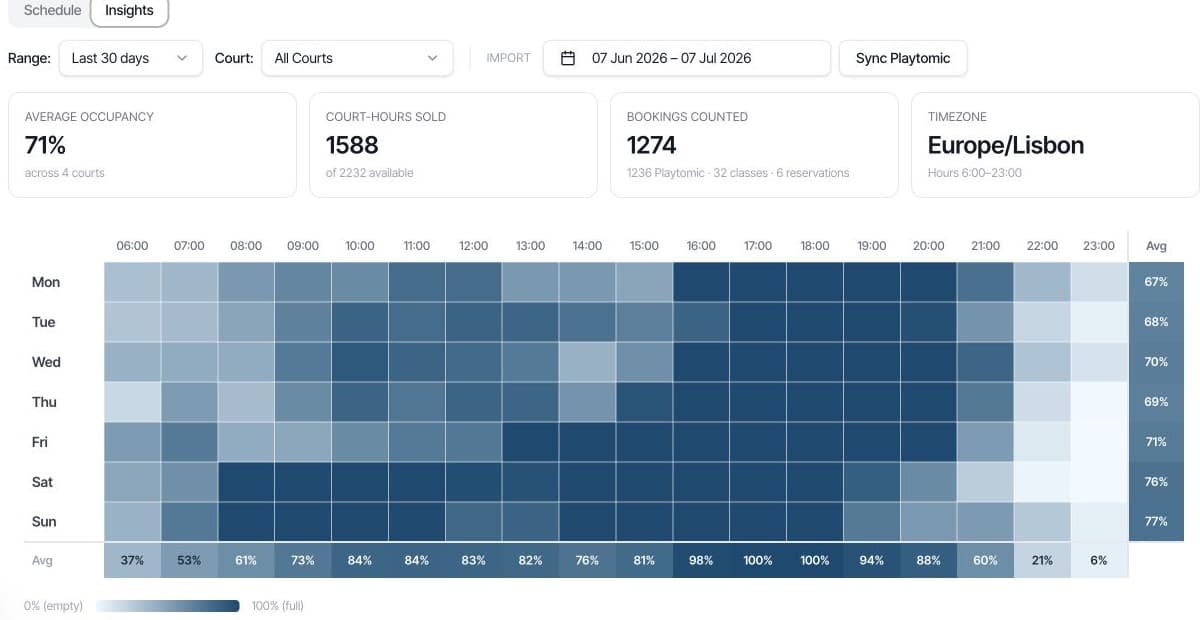
You do not need a national market report to see pressure building. Your own data shows it first:
| Signal | What to watch |
|---|---|
| Peak hours soften | Evening slots that used to sell out now have gaps |
| Discounting spreads | Discounts move from quiet hours into prime time |
| New supply nearby | A competitor opens within your players' travel distance |
| Fewer regulars | One-off bookings replace players who came weekly |
| Costs per hour rise | Energy and staff cost more per booked court-hour |
One signal on its own is noise. Two or three together, over a couple of months, are worth acting on.
What should club owners do now?
Build recurring programmes before you need them. Classes, academies, and leagues take months to grow. Start them while courts are still busy.
Know who your regular players are. Track who plays weekly, who has gone quiet, and who is in a class or membership. Retention is cheaper than finding new players in a crowded market.
Price by slot, not by habit. Protect peak prices and design specific offers for the hours you struggle to fill.
Grow capacity with demand, not ahead of it. European Business Magazine warns that the UK pipeline, projected at 1,300 to 1,400 courts by the end of 2026 from 1,004 in mid-2025, shows early signs of the Swedish pattern. Extra courts only pay off if the programmes to fill them already exist.
Frequently asked questions
Is the padel boom over?
Not globally. The Global Padel Report 2026 counts 58,334 courts at the end of 2025 and projects around 91,000 by 2028. What has ended in markets such as Sweden and Chile is growth built faster than demand. Those markets are correcting while others keep growing.
Why did so many padel clubs in Sweden go bankrupt?
Courts were built much faster than demand could fill them, energy costs for large indoor halls rose sharply, and a lot of the capital treated padel as a real-estate investment rather than a sports business that needs players to come back.
Which padel markets are at risk of overcapacity?
The Global Padel Report 2026 places Sweden, Finland, and Chile in a post-boom adjustment phase. European Business Magazine argues that the UK's fast build-out shows similar early signs. At club level, the best early warning is your own data: softening peak hours and spreading discounts.